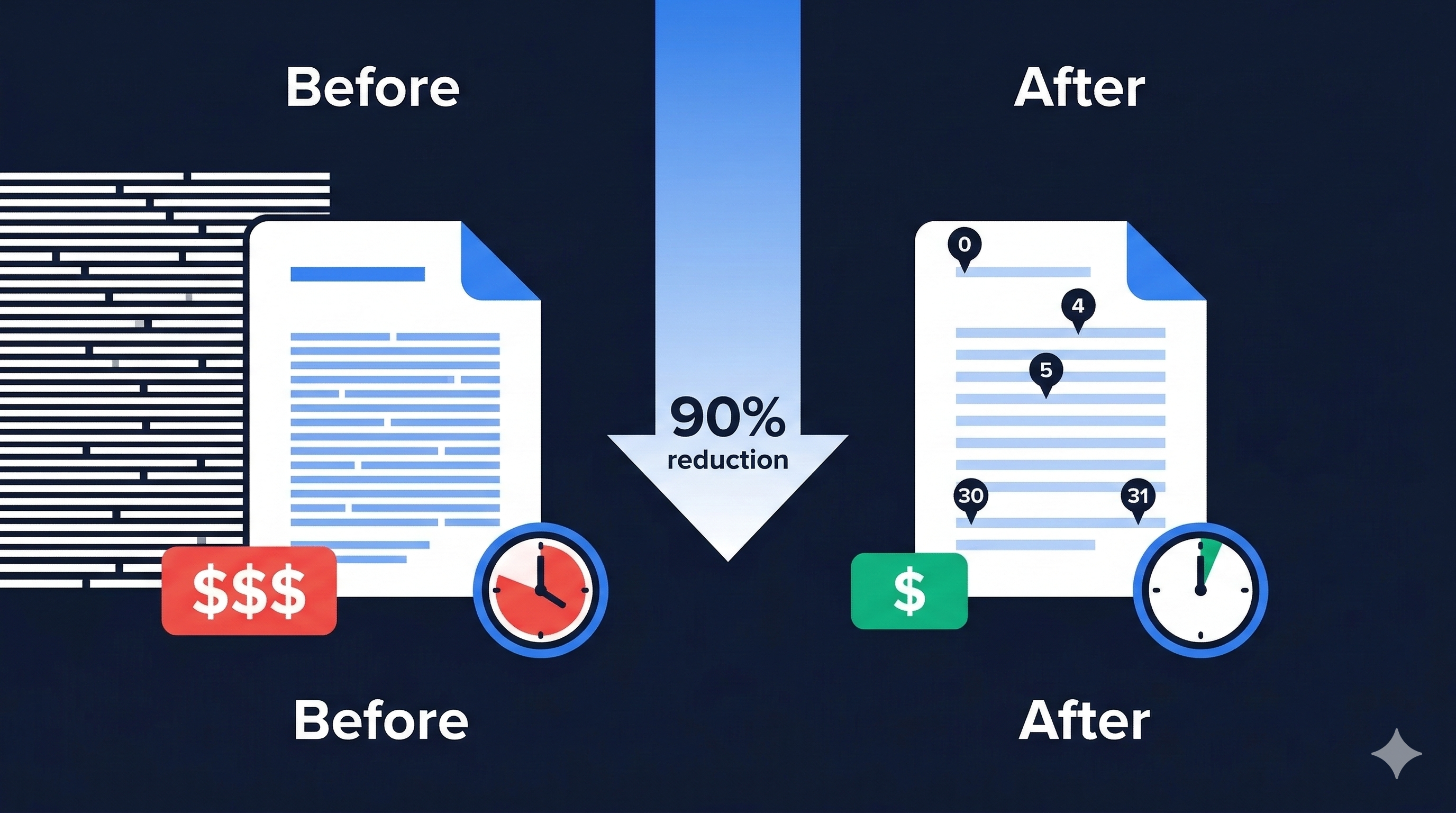
Architecture notice PDF page and LLM index reference method example

Cutting Output Tokens by 90% and Latency by 87% with Index References in LLM-Based PDF Chunking

TL;DR: Just ask the LLM “from where to where,” and let the server retrieve the text directly. Measured on 3 pages: 90% fewer output tokens, 87% lower latency, 61% cost savings. Background: From Docling to PyMuPDF + VLM While building an AI system for architecture regulation review, we needed to split architecture notice/guideline PDFs into semantically meaningful chunks. These chunks serve as retrieval units in a RAG pipeline. We initially used IBM’s Docling, which uses OCR models to analyze document structure before chunking. However, we ran into two problems: ...

March 9, 2026 · 6 min · Kim Bo-geun
Engineer repairing a server under a lamp

[Manufacturing AI Series — Troubleshooting] 279TB Manufacturing Data Collection Troubleshooting — From Hardware Limits to Consistency Guarantees

Virtualization-Based Edge Deployment · Pub/Sub Payload Limit Workaround · Idempotency-Based Consistency Overcoming pilot site surprises and cloud limitations in MDE optimization Cloud Tech Unit · GCP Delivery SA 3 Yoon Sung-jae | 2026-02-23 Problem Definition — Engineering in the Trenches No matter how perfect an architecture diagram looks, it often falls apart in front of rack-mount servers and network cables at a manufacturing site. While the previous article covered the “elegant” architecture, this one dives into the mud-and-guts troubleshooting that field engineers had to wrestle through during the pilot phase. ...

February 26, 2026 · 9 min · Yoon Sung-jae
Data center rack with fiber optic communication equipment

[Manufacturing AI Series — Architecture] MDE Architecture Design for 279TB Collection — Building an Edge-to-Cloud Pipeline Across 8 Factories

250+ Industrial Protocols · Edge-to-Cloud Pipeline · Physical-Level Project Isolation A real-world Manufacturing Data Engine deployment balancing security and cost trade-offs Cloud Tech Unit · GCP Delivery SA 3 Yoon Sung-jae | 2026-02-23 Business Background — PINN Model-Based Convergence Data Platform In manufacturing digital transformation (DX), the biggest hurdle is the “last mile” — securely and seamlessly moving on-site IT and OT data to the cloud. This article covers a case where, as the cloud infrastructure partner for the Korean government-led “2025 PINN (Physics-Informed Neural Networks) Model Manufacturing Convergence Data Collection and Validation Project,” we built an integrated system on Google Cloud Manufacturing Data Engine (MDE) for heterogeneous data from 8 manufacturing companies. ...

February 25, 2026 · 6 min · Yoon Sung-jae
Magnifying glass focusing on text in a document

Nearly Making an Illegal Building Legal: Catching Vision AI's Single-Character Hallucination

Author: Kim Bo-geun What happens when a building code review AI confuses “4 floors or less” with “4 floors or more”? The height limit gets inverted, and an illegal building gets judged as legal. This article is about the journey to catch that single-character difference. The Problem: Tables Are Retrieved but Unreliable The building code review system analyzes building-related PDFs — district unit plans, design guidelines — to extract standards like building coverage ratio (BCR), floor area ratio (FAR), and height limits. The PDF preprocessing pipeline uses Docling to parse documents, chunk text, and generate embeddings for hybrid search (keyword + semantic). ...

February 11, 2026 · 10 min · Kim Bo-geun
Data synchronization and performance optimization concept image

Incremental Sync of 448K CSV Records — 3-Layer Optimization from 52s to 0.3s

HTTP HEAD pre-check · High-Water Mark reverse scanning · Score threshold noise filtering Real-world guide to syncing 81MB CSV → PostgreSQL in a serverless environment Problem Definition — Why Optimization Was Needed I was implementing a “district unit plan notice matching” feature for a building code review AI system. When querying district unit plan information for a specific address via VWorld API, it returns ntfc_sn (notice serial number), but this number alone doesn’t provide access to the actual notice document. ...

February 6, 2026 · 12 min · Kim Bo-geun
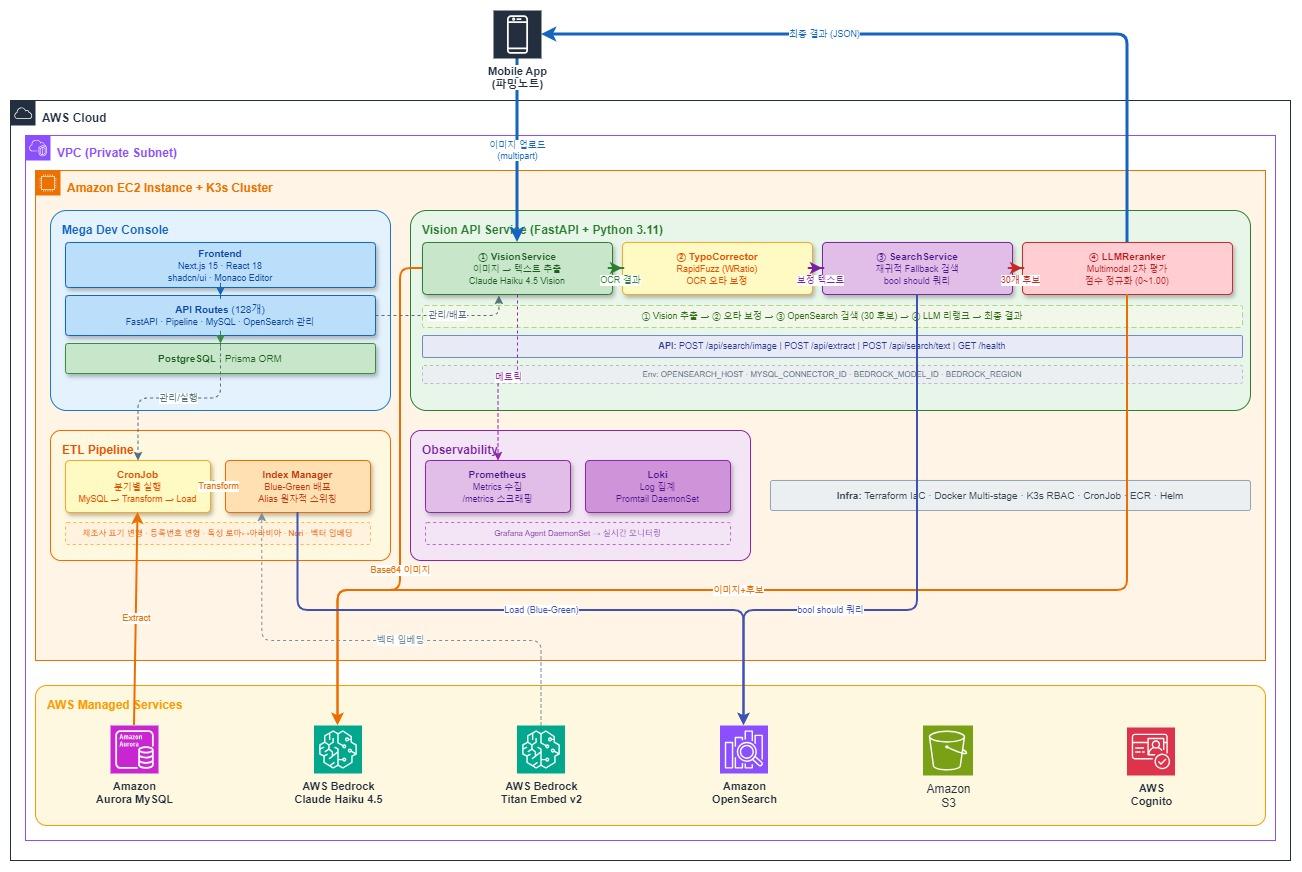
Pesticide product image recognition system architecture

Building a Pesticide Product Image Recognition System with AWS Bedrock Vision LLM and OpenSearch

Kyung Nong FarmingNote Enhancement Project — Sharing the design and implementation of an AI system that automatically searches product information from a single pesticide product photo. Project Background Kyung Nong had previously built a generative AI-based agricultural chatbot with AWS and Megazone Cloud. Using a RAG architecture with Amazon Bedrock Claude Sonnet 3.5 and OpenSearch, the service automatically responded to crop protection product queries in natural language. While operating this chatbot, we received meaningful field feedback and a new proposal from Kyung Nong. Given that many elderly farmers work in the field, typing long and unfamiliar pesticide product names on smartphones was very cumbersome. ...

February 2, 2026 · 11 min · Kim Bo-geun
AI-powered data network analysis concept image

Comparative Evaluation Report of Embedding Models for Korean Legal Documents

1. Evaluation Overview Objective: Select embedding models optimized for Korean statutes and ordinance search (RAG) systems Evaluation Dataset KCL-MCQA (Korean Canonical Legal Benchmark) 282 questions, 867 case law documents (expert-tagged Ground Truth) Rationale for Data Selection Currently, no public benchmark dataset exists for Korean statutes/ordinances KCL-MCQA is the only verified Korean search evaluation dataset in the legal domain Case law and statutes/ordinances share identical legal terminology and writing style, enabling similar embedding performance expectations Re-evaluation recommended when statute/ordinance-specific evaluation datasets are built Evaluation Environment ...

January 30, 2026 · 5 min · Kim Bo-geun